
NGEL Connects Fragmented Terminal Systems with AI

-
공유하기 선물하기


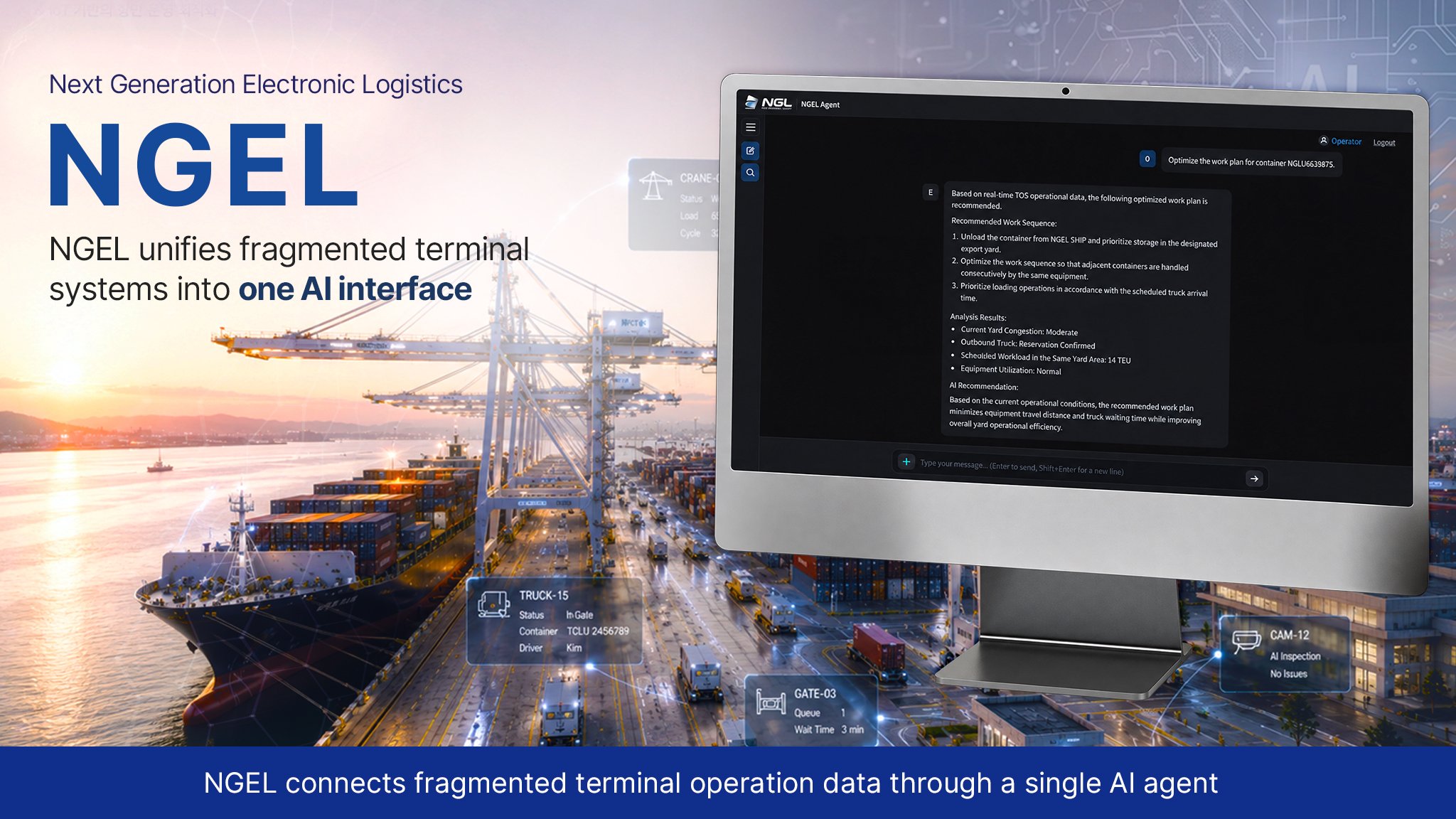
On-premises AI connects TOS, ECS and GOS data into a single intelligence layer to support faster, more consistent operational decisions
SEOUL, South Korea, Aug. 31, 2026 - NGL Co., Ltd. today introduced NGEL (Next Generation Electronic Logistics), an on-premises Operational AI Agent that unifies Terminal Operating System (TOS), Equipment Control System (ECS) and Gate Operating System (GOS) data into a single intelligence layer, turning cross-system data into prioritized, evidence-backed recommendations.
A Problem Hidden in Plain Sight
Terminals make thousands of time-sensitive decisions daily across vessels, yards, equipment and gates, yet the underlying data sits in separate TOS, ECS and GOS platforms. That forces operators to manually reconcile information before acting. That fragility now carries wider consequences: amid shifting U.S. tariff policy, a 2026 Thomson Reuters Global Trade Report found 72% of trade professionals now rank U.S. tariff volatility as the most impactful regulatory factor, up from 41% a year earlier. Because ports sit where ocean, inland and customs flows intersect, a single delay can ripple across the entire supply chain.
How NGEL Connects the Dots
NGEL reduces that fragmentation without replacing existing systems, linking real-time data from distributed platforms into a unified Operational Intelligence Layer so operators can evaluate a situation across systems at once. An operator states a goal in natural language; NGEL identifies the relevant systems, links the information, and returns prioritized recommendations with supporting evidence. At its core is Cross-System Reasoning, an architecture that analyzes data across systems around a single objective. For example, it can show how a yard equipment delay could affect gate throughput or vessel departure timing.
"Terminal operators don't need another dashboard. They need answers that connect the systems they already run," said Haekyoung Kwon, CEO of NGL Co., Ltd. "NGEL was built to reason across that complexity and provide recommendations operators can review and act on."
Proven Performance, Built-In Trust
NGL tested NGEL on 30 operational query scenarios in a self-hosted, on-premises setup. NGEL completed 90% of them successfully. It took an average of 3.7 seconds to produce a first response and 23.5 seconds to complete one. NGEL handles text, files and images. The company plans to file a patent on the core technology.
All computing runs on servers inside the terminal; no data leaves the site. Each recommendation comes with supporting evidence. Operators make the final call. They can review, edit, approve or reject any recommendation. NGEL does not execute commands on its own.
NGL plans to apply the same technology to airports, rail logistics and other industries.
NGL is refining NGEL with a commercial launch targeted for March 2027. Ahead of that, the company plans to unveil a new concept built on NGEL at CES 2027 in January.
About NGL Co., Ltd.
NGL Co., Ltd. is a Busan-based industrial AI company developing Operational AI solutions for complex logistics and mission-critical industrial environments. Its flagship platform, NGEL (Next Generation Electronic Logistics), connects fragmented operational systems into a unified intelligence layer, enabling faster, safer, and more consistent decision-making without replacing existing infrastructure. Headquartered in Busan, South Korea, NGL is focused on advancing AI-driven operations across container terminals, port logistics, and other industrial sectors where real-time coordination, security, and data sovereignty are critical.
Media Contact
Pureum Kim
Head of R&D|prkim@nglp.kr |Website




![[AI시대, 교육의 미래] 학벌의 시대는 끝나는가](https://s3.ap-northeast-2.amazonaws.com/image.themiilk.com/production/reports/1a0013f3ee2/41650af65d_1786727875.png)