DataFlare's Emission Guardian AI Identifies the Emitting Ship

-
공유하기 선물하기


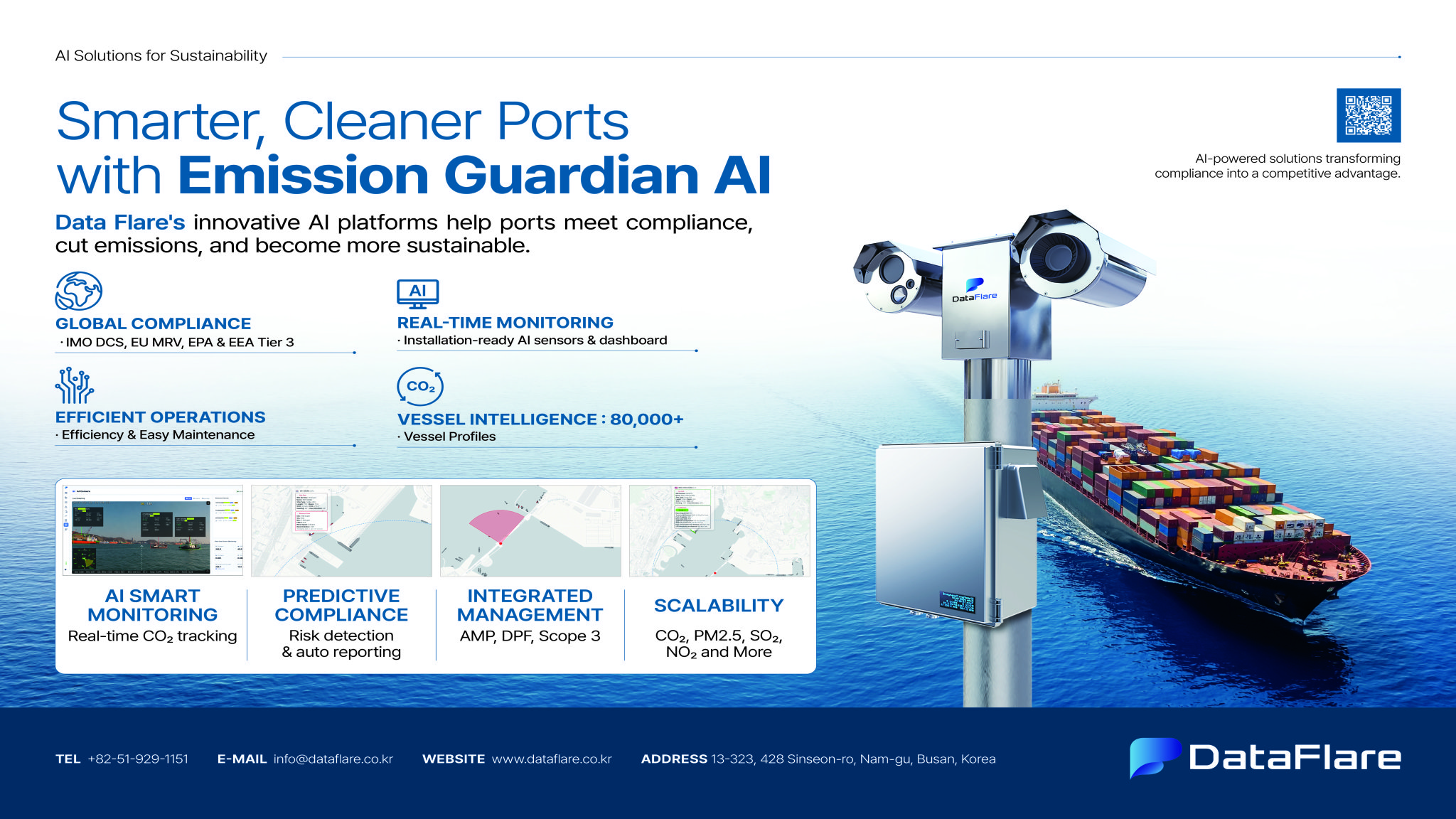
DataFlare's Emission Guardian AI works entirely from shore with no onboard hardware, lifting attribution reliability more than 30%.
BUSAN, South Korea, — A South Korean maritime AI company has developed shore-based technology that identifies which vessel produced a given emissions event, validated this year at Ulsan Port, as full EU carbon pricing pushes ports to prove vessel-level accountability.
Regulation Prices What Ports Cannot Yet Prove
International shipping produces roughly 3% of global carbon dioxide emissions, according to the International Maritime Organization. Since January 2026, the EU Emissions Trading System has covered 100% of in-scope emissions from ships of 5,000 gross tons and above calling at EU and EEA ports, penalizing shortfalls at 100 euros a ton. Estimates show how much was emitted. They rarely show which ship emitted it.
Vessel-Level Attribution Without Shipboard Equipment
Onboard monitoring measures directly but requires equipment on every vessel, a condition no port can impose. DataFlare's Emission Guardian AI works instead from land. It combines patented Vision AI, thermal imaging, fixed sensors, AIS positions, weather data and vessel records; tracks vessels between AIS updates; detects funnels, smoke and plumes; and applies wind back-trajectory analysis to identify the probable source. Results are tested against U.S. EPA engineering calculations and EEA Tier 3 criteria, methods regulators already recognize.
In company testing, multi-source validation improved attribution reliability more than 30% over sensor-only analysis, and cloud processing halved analysis time. A generative AI carbon agent turns verified findings into alerts, recommendations, scenarios and reports. Solar-powered off-grid units extend coverage to berths without grid power.
"Ports have emission estimates. They need reliable evidence showing which vessel is responsible and whether emissions are changing," said Sangyoung Lee, CEO of DataFlare. "Emission Guardian AI unites visual evidence, measurements and recognized methods in one workflow so port teams can act earlier."
Validated at Ulsan Port, Protected by Four Patents
Ulsan Port's 2026 proof of concept confirmed continuous 24-hour operation, vessel-level source attribution and applicability in live port conditions. DataFlare holds four registered Korean patents covering vessel tracking, emission monitoring, source attribution and secure data processing, with international protection for AI video analysis pending under PCT/KR2025/014056. The company placed first in Ulsan Port Authority's 2026 open innovation program, was selected for CMA CGM's ZEBOX Club and reached the semifinals of Singapore's PIER71 Smart Port Challenge.
Meet DataFlare at CES 2027
DataFlare will demonstrate Emission Guardian AI at the Venetian Expo during CES 2027, Jan. 6-9, in Las Vegas.
About DataFlare
Founded in Busan, South Korea, DataFlare Co., Ltd. develops maritime AI systems connecting Vision AI, environmental measurement, vessel data and web-based analytics. Its technology supports emission-source attribution, operational transparency and environmental decision-making for port authorities and terminal operators. DataFlare holds four registered Korean patents and is a member of CMA CGM's ZEBOX Club. Learn more at www.dataflare.co.kr.
Media Contact
Sangyoung Lee, CEO DataFlare Co., Ltd.




![[AI시대, 교육의 미래] 학벌의 시대는 끝나는가](https://s3.ap-northeast-2.amazonaws.com/image.themiilk.com/production/reports/1a0013f3ee2/41650af65d_1786727875.png)
![[AI 교육 혁명] 학벌의 시대는 끝나는가](https://s3.ap-northeast-2.amazonaws.com/image.themiilk.com/production/reports/19fd432c12a/c06ce82ee2_1785971550.png)